

By: W. Kirk Taylor, CFP®
When Kevin Warsh was sworn in as Chairman of the Federal Reserve this past May, one of the first people he mentioned was Alan Greenspan.¹ The comment lasted only a few seconds, but it immediately caught my attention.
Warsh wasn’t simply paying tribute to one of his predecessors. He was acknowledging a very different philosophy of central banking, one that viewed communication as something to be used carefully rather than continuously.
For much of Alan Greenspan’s tenure, the Federal Reserve revealed relatively little about its thinking. Policy statements were brief, press conferences didn’t exist, and investors often learned more by watching what the Fed did than by listening to what it said. Greenspan believed a central bank should communicate enough to guide expectations while preserving the flexibility to respond as economic conditions evolved.²
Over the past two decades, that philosophy has largely been reversed. Today’s Federal Reserve communicates through policy statements, press conferences, economic projections, speeches and interviews, creating an almost continuous dialogue with financial markets. Investors now analyze not only interest-rate decisions but individual words, punctuation and subtle changes in tone, searching for clues about what policymakers may do next.³
Warsh has suggested the pendulum may have swung too far. Whether he’s right remains to be seen.
His comments, together with the recent passing of Alan Greenspan at age 100, brought back a memory that has stayed with me for nearly four decades.⁴
October 19, 1987
On October 19, 1987, I was a 21-year-old finance student at the University of Tennessee sitting in Dr. William Goolsby’s Real Estate Finance class in the Glocker Business Building. It was a beautiful fall afternoon, and I was enjoying my senior year the way most college students do. Dressed in khaki shorts, a T-shirt, a ball cap and flip-flops, I settled comfortably into the last row of the auditorium-style classroom, where I could always gaze out the window if my mind started to wander.
Graduation was still months away, and I was looking forward to spending time with friends rather than thinking too much about what came after college. Financial markets certainly weren’t at the top of my mind.
That changed the moment Dr. Goolsby walked into the classroom.
He looked unusually unsettled. Someone asked what was wrong, and he replied simply,
“The Dow is down more than twenty percent.”
At the time, I didn’t fully appreciate what those words meant. I remember thinking that a twenty percent decline certainly sounded serious, but I had neither the experience nor the perspective to understand that I was witnessing the largest one-day percentage decline in the history of the U.S. stock market.⁵
Nor could I have imagined that less than a year later I would begin a career that would carry me through the savings and loan crisis, the technology bubble, the aftermath of September 11, the Global Financial Crisis, COVID, the highest inflation in four decades and one of the fastest interest-rate tightening cycles in modern history. Looking back, that afternoon in Dr. Goolsby’s classroom became the first chapter in an education that no textbook could have provided.
I also realize now that I was witnessing something else. Black Monday became one of the defining moments in the relationship between financial markets and the Federal Reserve.⁶
The following morning, newly appointed Chairman Alan Greenspan issued one of the shortest statements of his career:
“The Federal Reserve, consistent with its responsibilities as the nation’s central bank, affirmed today its readiness to serve as a source of liquidity to support the economic and financial system.”⁷
Although the statement contained only twenty-three words, it conveyed exactly what financial markets needed to hear. The Federal Reserve understood the seriousness of the situation and stood ready to provide liquidity to support the financial system. Those words were quickly reinforced with action as the Federal Reserve encouraged banks to continue extending credit and ensured that financial markets continued functioning normally.⁸
I’ve thought about that afternoon in Knoxville many times over the years. At the time, I thought I was witnessing an extraordinary day in the stock market. Looking back, I realize I was witnessing the beginning of a much broader lesson about markets, investor psychology and the role of the Federal Reserve.
The Briefcase Indicator
When I entered the investment business in 1988, the Federal Reserve operated very differently than it does today. There were no regularly scheduled press conferences after FOMC meetings, no quarterly economic projections and no “dot plot” showing where policymakers expected interest rates to go. Investors often had to infer the Federal Reserve’s intentions by observing its actions rather than reading its forecasts.⁹
That scarcity of information gave rise to one of Wall Street’s more entertaining traditions.
Before meetings of the Federal Open Market Committee, television cameras routinely followed Alan Greenspan as he walked toward the Federal Reserve building carrying his briefcase. Market commentators jokingly speculated that a thicker briefcase meant an important policy decision was coming, while a thinner one suggested a routine meeting.¹⁰
No one seriously believed the briefcase predicted monetary policy. What it revealed instead was how uncomfortable investors are with uncertainty. When reliable information is limited, markets have a remarkable ability to manufacture signals from almost anything.
Greenspan understood that instinct as well as anyone. His communication style eventually became known as “Greenspeak,” a term describing public remarks that often sounded precise while deliberately leaving room for interpretation. He later joked that if people believed they had clearly understood what he said, they had probably misunderstood him.¹¹
The philosophy became known as constructive ambiguity. The objective wasn’t secrecy. It was to communicate enough to guide expectations while preserving the flexibility to respond as economic conditions changed. In other words, Federal Reserve transparency came in shades of gray—perhaps even fifty shades of gray.¹²
That philosophy would gradually give way to something very different.
From Policy to Communication
The Federal Reserve’s communication strategy evolved over many years rather than changing overnight.
Beginning in 1994, policy decisions were announced immediately following FOMC meetings instead of being inferred from open market operations. Statements became more detailed, meeting minutes were released sooner, and the Federal Reserve eventually began publishing full transcripts after a five-year delay. These changes reflected a growing belief that transparency could improve the effectiveness of monetary policy by helping markets understand the Committee’s objectives and reasoning.¹³
The transformation accelerated after the Global Financial Crisis.
Under Chairman Ben Bernanke, communication itself became an instrument of monetary policy. The Federal Reserve increasingly relied on forward guidance, believing that expectations about future policy could influence borrowing costs, financial conditions and economic activity before interest rates actually changed. Janet Yellen and Jerome Powell largely continued that framework, expanding the use of press conferences, economic projections and other forms of public communication.¹⁴
The result was a fundamental change in the relationship between financial markets and the Federal Reserve.
Investors were no longer reacting solely to policy decisions. They were reacting to speeches, interviews, testimony before Congress and subtle revisions to official statements. A single word added—or removed—from an FOMC statement could move billions of dollars around the world within minutes.
Greater transparency undoubtedly gave investors more information. Whether it reduced uncertainty is less clear. In many respects, it simply shifted investors’ attention from deciphering the Federal Reserve’s actions to interpreting its language.
When One Sentence Moved Markets
Few episodes illustrate that evolution better than the Taper Tantrum of 2013.
On May 22, Chairman Bernanke testified before Congress that, if the economy continued to improve, the Federal Reserve might begin reducing the pace of its bond purchases “in the next few meetings.”¹⁵
It was a modest observation.
The Federal Reserve wasn’t raising interest rates. It wasn’t selling bonds or withdrawing liquidity from the financial system. Bernanke merely suggested that the pace of future bond purchases could eventually slow if economic conditions continued to improve.
Markets reacted immediately.
Treasury yields rose sharply over the following weeks, mortgage rates moved higher and investors around the world quickly repriced financial assets to reflect changing expectations about future monetary policy.¹⁶
The significance of the episode wasn’t the market’s volatility. Markets have always reacted to new information.
The significance was what the market was reacting to.
Investors were responding not to a policy decision, but to a discussion about a policy that had not yet been implemented. Communication had become an integral part of monetary policy itself, and expectations had become almost as influential as actions.
Warsh’s Experiment
Kevin Warsh understands that evolution better than most.
He served on the Federal Reserve Board from 2006 through 2011, participating in policy decisions during the housing collapse, the financial crisis and the unprecedented monetary response that followed. While he supported aggressive action during the crisis, he also expressed concern that the Federal Reserve risked becoming overly dependent on increasingly detailed guidance about its future intentions.¹⁷
That concern appears to be influencing his approach as Chairman.
Warsh’s first FOMC statement was noticeably shorter than those issued in recent years, and he has questioned whether extensive forecasts and highly detailed communications have become more helpful to markets than the discipline of allowing economic data to speak for itself.¹⁸
His argument is both simple and thought-provoking. Forecasts are conditional by nature, but investors often interpret them as commitments. When economic conditions change as they inevitably do, a central bank that has communicated too precisely may find itself constrained by expectations it never intended to create.
Whether Warsh’s approach ultimately succeeds is almost beside the point.
The larger question is whether investors have come to devote too much attention to the Federal Reserve and too little attention to the forces that ultimately create long-term wealth.
Interest Rates Influence. Profits Create.
If you’ve read this far, you might reasonably conclude that this commentary is about Federal Reserve transparency. It isn’t. It’s about perspective.
The Federal Reserve influences one of the most important prices in the economy: the price of money. That influence matters because interest rates affect borrowing costs, investment decisions, asset valuations and the allocation of capital throughout the financial system. Lower rates encourage some behaviors, while higher rates discourage others. Monetary policy changes incentives, and incentives influence behavior throughout the economy.¹⁹
Influence, however, should not be confused with creation. The Federal Reserve does not create wealth. Productive businesses do.
That distinction may seem subtle, but I believe it is one of the most important concepts in investing. Businesses create products, provide services, solve problems, develop new technologies and improve productivity. When they execute well, they earn profits, and those profits rarely remain idle.
They are reinvested in research and development, factories, software, equipment and acquisitions. They are distributed to shareholders through dividends and share repurchases. They are paid to employees as wages and bonuses, to governments as taxes and to lenders as interest.²⁰
Every dollar of corporate profit ultimately goes somewhere. In one form or another, it becomes someone else’s income, financing tomorrow’s investment, consumption or innovation. That process repeats itself millions of times each day and serves as the quiet engine that drives long-term economic growth.²¹
The Federal Reserve influences the environment in which that engine operates. It does not replace the engine.
The Market Doesn’t Wait for the Federal Reserve
One of the more persistent misconceptions in investing is that markets wait for the Federal Reserve before deciding where to go next. History suggests otherwise.
Consider the most recent tightening cycle.
The Federal Reserve delivered its first increase in the federal funds rate on March 16, 2022. By then, however, the S&P 500 had already declined roughly nine percent from its January peak. Investors weren’t reacting to the first rate increase; they were discounting the expectation of many more.²²
The market ultimately reached its low on October 12, 2022, yet the Federal Reserve continued raising interest rates for another nine months. The final increase did not occur until July 26, 2023.²³
That sequence deserves more attention than it usually receives.
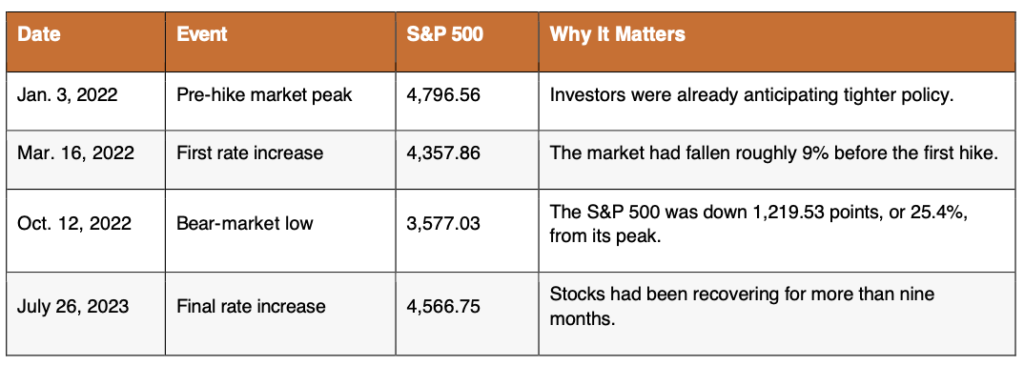
The market peaked before the first rate hike and bottomed well before the final one. Neither turning point coincided with the headlines dominating financial news at the time.
Markets were doing what they have always done. They were looking ahead, continually reassessing inflation, economic growth and, perhaps most importantly, the future path of corporate earnings.
That’s because markets don’t simply react to today’s economy. They continuously discount expectations about tomorrow’s.²⁴
The relationship between earnings and stock prices is neither immediate nor perfect. Markets can become detached from fundamentals for surprisingly long periods of time, as they did during the technology bubble when investor enthusiasm drove prices well beyond what underlying profits could support. Eventually, reality reasserted itself.²⁵
The opposite occurred during the Global Financial Crisis. Corporate earnings deteriorated rapidly, and stock prices followed.²⁶
The 2022 correction tells a different story.
Stock prices declined sharply as investors adjusted to a dramatically higher interest-rate environment, but corporate earnings proved considerably more resilient than many had expected. Once investors gained confidence that profitability would hold up despite tighter monetary policy, stocks began recovering even though the Federal Reserve had not yet finished raising rates.²⁷
I spend a great deal of time studying market history, and very few charts have influenced my thinking more than the one below.
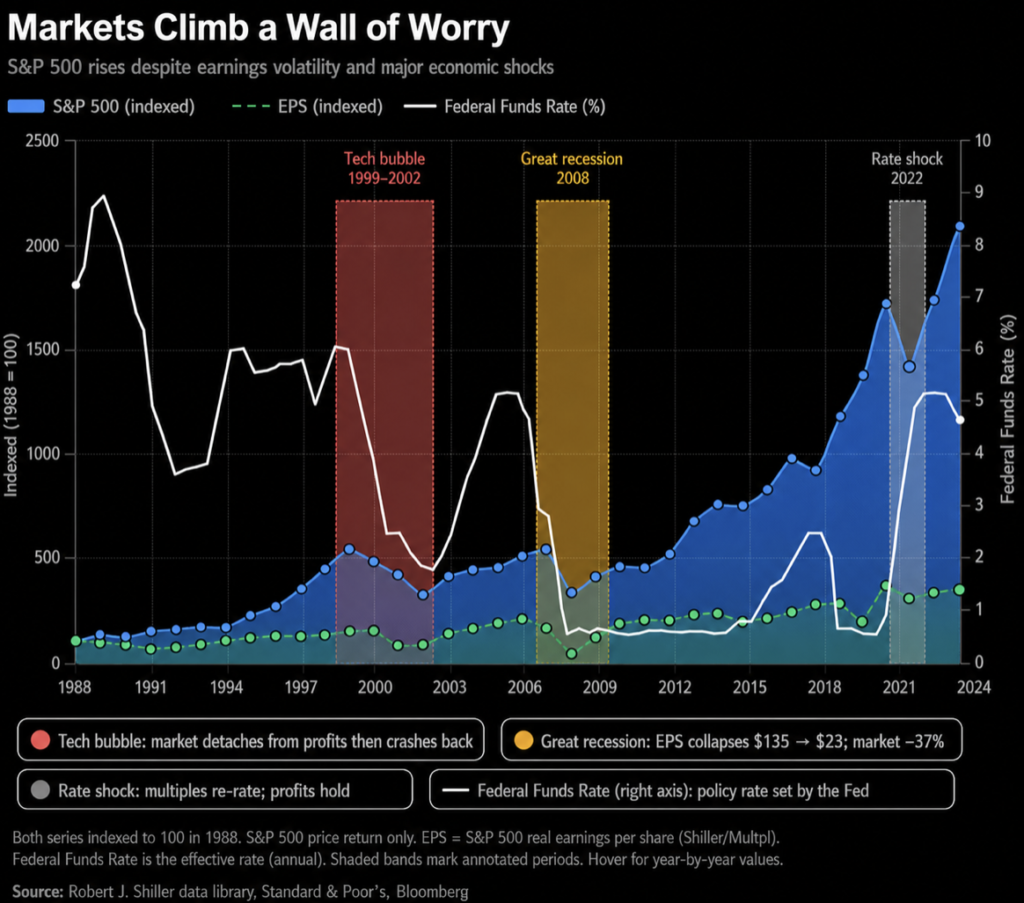
That distinction is important.
Higher interest rates compressed valuation multiples, increased borrowing costs and altered investment decisions throughout the economy.
Those effects were both real and significant. The recovery, however, depended on something else. It depended on the market’s growing confidence that America’s businesses would continue earning money.
That’s why I believe interest rates influence the journey, but corporate profits ultimately determine the destination.
The Housing Market Offers Another Lesson
Housing provides another example of how monetary policy influences economic behavior long after the policy itself has changed.
During the pandemic, mortgage rates briefly fell below three percent. Millions of homeowners refinanced, while millions of others purchased homes at financing costs that, in retrospect, proved extraordinarily attractive. The immediate effects were obvious: monthly payments declined, affordability improved, demand increased and home prices rose.²⁸
The longer-term effects were less obvious.
Today, many homeowners are reluctant to sell because doing so would require exchanging a three-percent mortgage for one carrying a substantially higher interest rate. Economists refer to this as the “lock-in effect,” and it has become one of the defining characteristics of today’s housing market. Existing-home inventory remains constrained not because people necessarily want to stay where they are, but because the economics of moving have changed dramatically.²⁹
Few homeowners in 2021 were thinking about lock-in risk.
Yet today’s housing market continues to reflect financing decisions made several years ago. Monetary policy often leaves fingerprints that remain visible long after interest rates themselves have changed.³⁰
That, perhaps more than anything else, illustrates how the Federal Reserve influences the economy. The first-order effects receive the headlines. The second-order effects quietly reshape consumer behavior, capital allocation and economic activity for years.
What Really Drives Long-Term Wealth?
Financial markets naturally devote enormous attention to the Federal Reserve. Monetary policy is visible, immediate and easy to discuss. Corporate profitability is something else entirely. It develops gradually through thousands of decisions made every day by managers allocating capital, employees creating value, entrepreneurs taking risks and consumers deciding where to spend their money.
That process is less dramatic than an FOMC press conference, but it is ultimately more important.
Over long periods of time, successful investing has been less about predicting the next interest-rate decision than identifying businesses capable of generating growing earnings, strong cash flow and attractive returns on capital through a variety of economic environments.³¹
Interest rates matter. They always will.
But they are only one of many variables that influence long-term investment outcomes. Innovation, productivity, sound management, competitive advantage and disciplined capital allocation have ultimately proven far more durable sources of wealth creation.
For that reason, I continue to believe that corporate profits—not Federal Reserve press releases—remain the primary driver of long-term stock prices.³²
How I See It
Clients often ask what I think the Federal Reserve is going to do next. It’s a fair question because interest rates influence nearly every corner of the economy. They affect mortgage rates, business investment, commercial real estate, bond prices and, at least over shorter periods, stock valuations. Ignoring the Federal Reserve would be a mistake. Obsessing over it can be one as well.³³
Early in my career, I devoted more time than I should have to anticipating the Federal Reserve. Like many investors, I evaluated policy statements and speeches and looked for subtle clues about what policymakers might do next. There is value in understanding monetary policy, but experience gradually led me to a different conclusion. The more useful question isn’t what the Federal Reserve is likely to do at its next meeting. It’s what America’s best businesses are likely to earn over the next five or ten years.
Those questions are related, but they are not the same. One focuses on the economic environment; the other focuses on the engine that ultimately drives wealth creation.
The Federal Reserve influences that environment by affecting the cost of capital, the availability of credit and the incentives facing consumers and businesses. Productive businesses, however, create wealth by innovating, investing, competing and allocating capital effectively. When they do those things well, they generate profits that are reinvested, distributed, taxed and spent, supporting tomorrow’s factories, software, medical breakthroughs and jobs.
That process has continued through every Federal Reserve chairman of my career—from Greenspan to Bernanke, Yellen, Powell and now Warsh—and I expect it will continue long after today’s policy debates have faded into history.³⁴
None of this suggests that markets move in straight lines. Valuations can become detached from fundamentals for months or even years, and investor enthusiasm or fear can push prices well above or well below intrinsic value. Interest rates influence those swings, sometimes dramatically. Over longer periods, however, history suggests that businesses capable of consistently growing earnings, generating cash flow and allocating capital wisely have rewarded patient owners.³⁵
When I think back to that afternoon in Dr. Goolsby’s classroom, I don’t remember where the Dow closed. I don’t remember the level of the S&P 500 or the yield on the 10-year Treasury. What I remember is the expression on his face and the realization that something significant had happened, even if I didn’t yet understand its full importance.
Since then, I’ve lived through Black Monday, the savings and loan crisis, the technology bubble, the Global Financial Crisis, COVID, the highest inflation in forty years and one of the fastest interest-rate tightening cycles in modern history. Each episode convinced many investors that the current crisis or the current policy decision would permanently redefine the investment landscape. Some developments did change markets in meaningful ways. Human nature, however, changed very little.
Investors have always been tempted to focus on whatever seems most urgent in the moment. Today, that happens to be the Federal Reserve. Tomorrow it will be something else. The more enduring challenge has never been distinguishing good news from bad news; it has been distinguishing information that changes the long-term value of businesses from information that simply dominates today’s headlines.
That is why I found Kevin Warsh’s comments about Federal Reserve transparency so interesting. Not because I believe they will determine the direction of the stock market over the coming months, but because they remind us how easily our attention can become fixed on the visible rather than the consequential.
The Federal Reserve matters because it influences the environment in which businesses operate. Interest rates matter because they affect the cost of capital. Transparency matters because expectations influence financial markets. Perspective matters most because it determines where we choose to direct our attention.
The investors I’ve admired most over the past four decades were rarely the ones who spent the most time trying to predict the Federal Reserve’s next move. They spent their time studying businesses, evaluating management teams, understanding competitive advantages and thinking carefully about where earnings would come from years into the future. In my experience, that has always been the more reliable path to long-term investment success.
As I look back on nearly four decades in this profession, I’m reminded that headlines are temporary, but the principles that create wealth are remarkably durable. The Federal Reserve will continue to influence markets, just as it always has.
Yet over the long run, it is productive businesses—not central banks—that create wealth. That’s where I believe the real story has always been and that’s how I see it.
Kirk
Endnotes
1. Board of Governors of the Federal Reserve System, Remarks by Chairman Kevin Warsh at His Swearing-In Ceremony, May 2026.
2. Alan Greenspan, The Age of Turbulence: Adventures in a New World (New York: Penguin Press, 2007); Board of Governors of the Federal Reserve System, “Biography of Alan Greenspan.”
3. Board of Governors of the Federal Reserve System, “History of FOMC Communications”; Ben S. Bernanke, The Courage to Act (New York: W.W. Norton, 2015).
4. Obituary or official announcement confirming Alan Greenspan’s passing. (Verify this reference before publication.)
5. Dow Jones Industrial Average declined 22.61% on October 19, 1987 (“Black Monday”), the largest one-day percentage decline in its history. See Federal Reserve History, “The Stock Market Crash of 1987”; Mark Carlson, A Brief History of the 1987 Stock Market Crash with a Discussion of the Federal Reserve Response, Finance and Economics Discussion Series 2007-13 (Board of Governors of the Federal Reserve System, 2007).
6. Mark Carlson, A Brief History of the 1987 Stock Market Crash; Federal Reserve History, “The Stock Market Crash of 1987.”
7. Board of Governors of the Federal Reserve System, “Statement by Chairman Alan Greenspan,” October 20, 1987.
8. Mark Carlson, A Brief History of the 1987 Stock Market Crash; Ben S. Bernanke, The Courage to Act, discussion of the Federal Reserve’s role as lender of last resort.
9. Board of Governors of the Federal Reserve System, History of the Federal Open Market Committee; Ben S. Bernanke, The Courage to Act (New York: W.W. Norton, 2015), chapters on Fed communications.
10. Roger Lowenstein, When Genius Failed (New York: Random House, 2000), discussion of Greenspan-era market culture; numerous contemporaneous CNBC reports and Wall Street commentary referring to the “Briefcase Indicator.”
11. Alan Greenspan, The Age of Turbulence: Adventures in a New World (New York: Penguin Press, 2007); Bob Woodward, Maestro: Greenspan’s Fed and the American Boom (New York: Simon & Schuster, 2000).
12. William Greider, Secrets of the Temple (New York: Simon & Schuster, 1987); Alan Blinder, Central Banking in Theory and Practice (MIT Press, 1998).
13. Board of Governors of the Federal Reserve System, “History of FOMC Policy Communications”; Federal Reserve Bank of St. Louis, FOMC Communication Timeline.
14. Ben S. Bernanke, The Courage to Act; Janet L. Yellen, selected speeches (2014–2017); Jerome H. Powell, FOMC press conferences and Federal Reserve communications archive.
15. Ben S. Bernanke, Testimony before the Joint Economic Committee, U.S. Congress, May 22, 2013.
16. Federal Reserve Bank of St. Louis, “The Taper Tantrum”; International Monetary Fund, World Economic Outlook (2013); U.S. Treasury historical yield data.
17. Board of Governors of the Federal Reserve System, Biography of Kevin Warsh; Kevin M. Warsh, speeches and essays on monetary policy (2006–2011).
18. Board of Governors of the Federal Reserve System, FOMC statements and speeches by Chairman Kevin Warsh (2026), together with public remarks discussing the role of forward guidance and central bank communications.
(Washington, DC: Board of Governors, latest edition); Frederic S. Mishkin, The Economics of Money, Banking, and Financial Markets, 13th ed. (Pearson, 2022).
20. John C. Cochrane, Asset Pricing, revised ed. (Princeton University Press, 2005); Richard A. Brealey, Stewart C. Myers, and Franklin Allen, Principles of Corporate Finance, 14th ed. (McGraw-Hill, 2023).
21. U.S. Bureau of Economic Analysis, National Income and Product Accounts (NIPA); Gregory Mankiw, Macroeconomics, 11th ed. (Worth Publishers, 2023).
22. Board of Governors of the Federal Reserve System, FOMC Statement, March 16, 2022; S&P Dow Jones Indices, historical S&P 500 index levels.
23. Board of Governors of the Federal Reserve System, FOMC Statements, October 2022 through July 26, 2023; S&P Dow Jones Indices; Federal Reserve Bank of St. Louis (FRED), Effective Federal Funds Rate.
24. Eugene F. Fama, “Efficient Capital Markets: A Review of Theory and Empirical Work,” Journal of Finance 25, no. 2 (1970): 383–417; Burton G. Malkiel, A Random Walk Down Wall Street, 14th ed. (W.W. Norton, 2023).
25. Robert J. Shiller, Irrational Exuberance, 3rd ed. (Princeton University Press, 2015); Jeremy J. Siegel, Stocks for the Long Run, 6th ed. (McGraw-Hill, 2022).
26. Standard & Poor’s, S&P 500 Earnings and Estimate Reports; Robert J. Shiller, online historical earnings database; National Bureau of Economic Research, chronology of the Great Recession.
27. FactSet, Earnings Insight (Q3 and Q4 2022; 2023 editions); S&P Dow Jones Indices; Federal Reserve Board FOMC Statements (2022–2023).
28. Freddie Mac, Primary Mortgage Market Survey (PMMS), 2020–2021; Federal Housing Finance Agency (FHFA), Mortgage Market Activity Reports; National Association of Realtors (NAR), Existing Home Sales.
29. Federal Housing Finance Agency, The Lock-In Effect of Low Mortgage Rates (working paper, 2023); Federal Reserve Bank of Philadelphia, “Mortgage Rate Lock-In and Housing Mobility”; National Bureau of Economic Research (NBER), research on mortgage lock-in and housing supply.
30. Federal Reserve Bank of Kansas City, Economic Review: housing market effects of monetary policy; Federal Reserve Bank of New York, research on housing finance and monetary transmission.
31. Jeremy J. Siegel, Stocks for the Long Run, 6th ed. (New York: McGraw-Hill, 2022); John C. Bogle, The Little Book of Common Sense Investing, updated ed. (Hoboken, NJ: Wiley, 2017); Warren E. Buffett, Berkshire Hathaway Shareholder Letters (selected years).
32. Robert J. Shiller, Irrational Exuberance, 3rd ed. (Princeton University Press, 2015); Eugene F. Fama and Kenneth R. French, “The Cross-Section of Expected Stock Returns,” Journal of Finance 47, no. 2 (1992); Standard & Poor’s, historical S&P 500 earnings and index data.
33. Board of Governors of the Federal Reserve System, The Fed Explained: What the Central Bank Does (Washington, DC: Board of Governors, latest edition); Frederic S. Mishkin, The Economics of Money, Banking, and Financial Markets, 13th ed. (Pearson, 2022).
34. Board of Governors of the Federal Reserve System, biographies of Alan Greenspan, Ben S. Bernanke, Janet L. Yellen, Jerome H. Powell and Kevin Warsh; Federal Reserve historical archive.
35. Jeremy J. Siegel, Stocks for the Long Run, 6th ed. (New York: McGraw-Hill, 2022); Warren E. Buffett, Berkshire Hathaway Inc., Annual Shareholder Letters (selected years); Robert G. Hagstrom, The Warren Buffett Way, 4th ed. (Wiley, 2013).